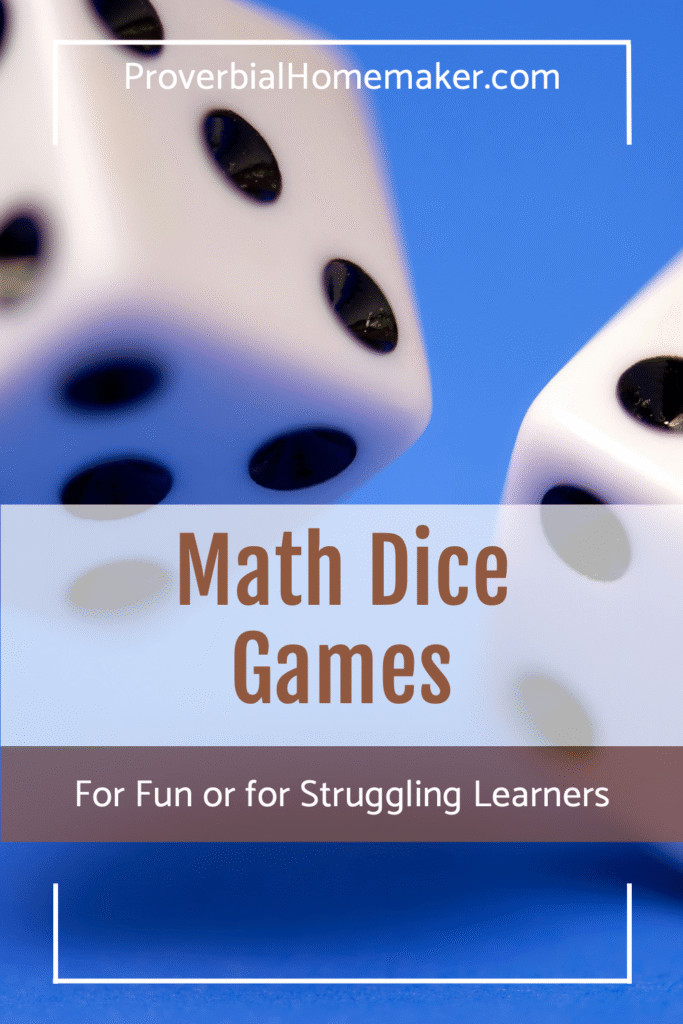
Math Dice Games for Fun — or for Struggling Learners

Disclosure: *This post may include affiliate links. As an affiliate, I earn from qualifying purchases. Read the disclosures and terms for more information.
Is math time each day bringing tears, boring worksheets, or daily battles along with it? You’re not alone! For many homeschoolers, especially those teaching children who struggle with math, a simple set of dice can become one of the most effective tools you can use.
Dice games are a fun, low-pressure way to build in math practice and can be used across many ages and skill levels. They also create space for joy, connection, and confidence… who doesn’t want more of that in their homeschool? For kids who’ve developed a sour taste for all things math, it can be especially valuable.
“Why Do I Have to Learn Math?”
If you’ve been homeschooling for more than a couple of years, you’d had this question. 😀 Yes, making math fun and engaging helps! But answering this question helps a lot as well.
In addition to all the real-world and academic uses for math, there are biblical reasons, too. Scripture consistently presents God as a God of order, number, and design.
“But all things should be done decently and in order.” (1 Corinthians 14:40)
From the measured dimensions of the Tabernacle to the careful accounting found throughout Scripture, mathematics reflects God’s character. Learning math unlocks amazing principles that give us a glimpse of the Creator.
(For an excellent resource to dig into this more yourself or for your older children, check out what Jason Lisle, PhD has to say in this video or the book Fractals.)
As much as possible, help your kids to not only learn math but to enjoy it, because it points us to God! Math dice games is a fantastic tool to do this.
Why Dice Games Are Effective for Homeschool Math
Dice games work well for kids because they gently address many of the common pain points we experience when teaching or learning it:
Short practice bursts instead of long worksheets
Natural repetition without boredom
- Immediate feedback
- Multi-sensory learning (seeing, touching, verbalizing)
- Low emotional stakes (mostly… we do have our competitive ones haha)
Because dice outcomes are random, children are freed from the pressure of “getting the right answer” every time. Instead, they focus on process and reasoning.
Why Dice Games Are Especially Helpful for Struggling Learners
Struggling learners often need more repetition, smaller steps, and reduced cognitive load. Dice games provide all of these things and help increase the confidence of your child so that they know they CAN do math!
The games allow your children to practice the same concept over and without even really realizing it. Mistakes feel less personal because the dice (instead of the kiddo themselves) “caused” the problem.
Dice games also work well for:
Children with math anxiety
Dyslexic or dyscalculic learners
Reluctant math students
Engaging multiple ages together in math learning
How to Incorporate Dice Games Regularly
Dice games are most effective when they are routine, not occasional. As a busy mom, this is the hardest part. :/ Try these options out:
Add math games to a group or individual student’s loop schedule
Use a dice game as a warm-up before regular math lessons
Replace one worksheet per week with a game
Keep a “math games basket” for independent practice
Use games orally during morning time
Play collaboratively with siblings
Consistency matters more than duration. Ten minutes three times a week can help gradually strengthen math skills over time, and that’s what you’re aiming for!
Math Dice Game Ideas (With Variations)
1. Roll & Add / Roll & Multiply
How it works:
Roll two dice. Add or multiply the numbers.
Variations:
Roll three dice for advanced students
Require mental math only
Use one die as the multiplier (times tables practice)
Skills practiced:
Addition, multiplication, number sense
2. Target Number
How it works:
Choose a target number (e.g., 20). Roll two or three dice and use any operation to reach the target.
Variations:
Require use of all dice
Limit allowed operations
Compete cooperatively to reach the target in the fewest rolls
Skills practiced:
Problem solving, operations, flexibility in thinking
3. Dice Difference
How it works:
Roll two dice. Subtract the smaller number from the larger.
Variations:
Add a third die and subtract sequentially
Require explanation of the strategy used
Skills practiced:
Subtraction, comparison, reasoning
4. Place Value Builder
How it works:
Roll dice to create numbers (e.g., hundreds, tens, ones). Compare numbers or write them in expanded form.
Variations:
Use decimal place values
Compete to build the largest or smallest number
Skills practiced:
Place value, number construction
5. Fraction Roll
How it works:
Roll two dice to form a fraction (one numerator, one denominator). Compare fractions or convert to decimals.
Variations:
Require simplification
Order fractions from least to greatest
Skills practiced:
Fractions, simplification, comparison
6. Story Problem Dice
How it works:
Roll dice to generate numbers and create a word problem that matches the operation being studied.
Variations:
Oral only
Student explains how to solve their own problem
Skills practiced:
Word problems, language integration, reasoning
Looking for more math games that are open-and-go? Check these out:
- Yahtzee – The classic we grew up with! This is a fun game for 2 or more players (8 and up) and is a fantastic addition to your stash.
Shut the Box Dice Game – Kids like this box layout and interactive style to use with the dice. It gets great reviews, too!
ThinkFun Math Dice Jr. – This one’s good for travel, too. Great for kids 6 and up
Scholastic Math Match Travel Dice Game – A fun one for ages 5 and up with oversized dice the kids like to roll.
ThinkFun My First Math Dice – For the earliest learners (3+) this one’s great for number recognition and counting.
Aizweb Math Dice – This one uses flash cards along with dice for addition, subtraction, multiplication, and division.
Matrix Dice Game by Pop & Play – A more advanced dice game that also uses fun pop-it boards for your tactile learners (like the pop fidget things)
PlaySmart Deluxe Math Dice Set – 11 games for ages 6 and up, and includes a travel bag. This one seems to be a top pick, too!
Do you have any fun math dice games in your family?
Add games to your loop schedule!…
I know how it is to feel overwhelmed with what you already have on your plate. So, adding math games to your day might sound good, but how do you make it happen!
I highly recommend trying loop scheduling. You can read all about it here!
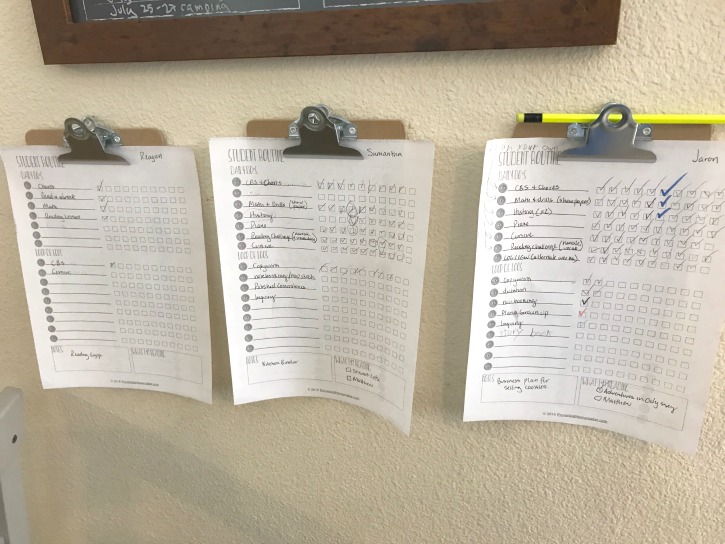
Then download a loop scheduling template and give it a try. This will help you incorporate math games once a week or so, without any worry if a week goes south and you don’t get to it. Yay!